
Posifa Liquid Flow Sensors for Ultra-Low-Flow Medical and Microfluidic Systems
The News
Posifa’s PLF2000 Series liquid flow sensors are a MEMS-based platform optimized for ultra-low liquid flow control in compact medical, life science, and lab automation equipment. With measurement ranges from 0–30 mL/min up to 0–200 mL/min, PLF2000 sensors help designers achieve stable, repeatable microflow delivery where even small deviations can affect assay integrity, dosing accuracy, or experimental outcomes.
Optimized for Medical, Life Science, and Lab Automation
The PLF2000 microflow family supports reliable, outcome-driven flow control in applications such as:
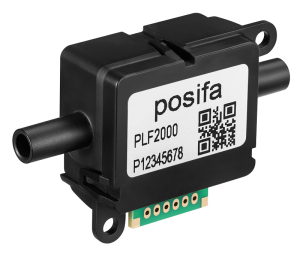
- Lab automation reagent delivery that benefits from reduced waste and more consistent test results
- Microfluidics and organ-on-chip perfusion where tight flow stability protects cell health
- Flow cytometry and cell sorting fluidics where controlled delivery improves repeatability
- Benchtop and production bioreactors where precise flow helps maintain target process conditions
- Rodent infusion pumps for pharma research where accurate microdosing supports cleaner data
- Infusion and micro-infusion pumps where preventing dosing overshoot is critical
- HPLC and analytical instruments where stable low-flow measurements support consistent runs
- Compact medical devices where predictable flow control improves safety margins
These sensors support tightly integrated system designs, from benchtop instruments to portable and home-use medical devices, while helping teams reduce iteration cycles during calibration and verification.
Ultra-Low Flow Performance for Tight Closed-Loop Control
Built on Posifa’s MEMS thermal flow technology, the PLF2000 Series brings microfluidic-level performance to liquid systems and helps engineers:
- Achieve stable closed-loop control at microflow levels
- Prevent dosing overshoot in small-volume delivery systems
- Reduce reagent waste in cost-sensitive assays
- Improve run-to-run consistency in automated workflows
Key performance enablers include:
- Ultra-low flow ranges optimized at ≤ 200 mL/min
- Fast response around 100 ms for tighter control in small-volume loops
- Very low pressure drop with a straight, unobstructed flow path
- No moving parts for long-term stability and fewer recalibration events
- Push-to-connect fitting option to simplify manifold and tubing integration
Designed for Safe, Direct Liquid Contact
PLF2000 sensors are designed for direct contact with water and compatible process liquids and help streamline compliance and system integration:
- Comply with NSF/ANSI 61 requirements for drinking water system components
- Fit easily into dense medical and life science layouts, supporting compact instrument designs
- Offer both analog voltage and digital I²C outputs for faster integration with embedded controllers
PLF2000 Series at a Glance
All PLF2000 devices provide linear output over their specified range, with both analog and I²C interfaces:
|
Model |
Typical flow range |
Outputs |
| PLF2003 | 0–30 mL/min | Analog, I²C |
| PLF2040 | 0–40 mL/min | Analog, I²C |
| PLF2005 | 0–50 mL/min | Analog, I²C |
| PLF2010 | 0–100 mL/min | Analog, I²C |
| PLF2020 | 0–200 mL/min | Analog, I²C |
All variants are rated up to 50 psi operating pressure, giving added margin for pressurized fluid paths.
Key Benefits for Medical and Microfluidic Designs
- Improve dosing accuracy and reduce risk of overshoot
- Reduce reagent waste and lower per-test cost
- Achieve stable closed-loop control in small-volume systems
- Minimize backpressure impact through low pressure drop
- Extend service life with solid-state construction and no moving parts
- Simplify pump, cartridge, and manifold integration with a compact, tubing-friendly form factor
- Support both legacy and modern architectures with analog + I²C outputs