
Precision Flow Control for Nitric Oxide Therapy
Nitric oxide (NO) therapy is widely used in neonatal and critical care, where safe delivery depends on precise dosing, stable gas flow, and continuous verification. However, because NO is both reactive and toxic at improper concentrations, even small deviations in flow can impact treatment effectiveness and patient safety.
To meet these demands, medical device manufacturers rely on advanced sensing technologies that can maintain accuracy under challenging conditions.
The Role of MEMS Flow Sensors in NO Therapy Systems
MEMS mass flow sensors provide the precision and responsiveness required for nitric oxide delivery systems. By enabling accurate measurement and real-time control of gas flow, these sensors support safe dosing, system stability, and reliable verification throughout the therapy process.
Precise Flow Control for Gas Blending
NO delivery systems must dilute high-concentration source gas to levels typically between 1 ppm and 80 ppm.
MEMS flow sensors enable:
- High-sensitivity measurement at low flow rates
- Real-time monitoring to maintain stable mixing ratios
- Fast response for closed-loop control
- Minimal pressure drop to preserve regulator performance
This allows systems to deliver consistent and repeatable NO concentrations.
Accurate Sampling and Verification
To confirm delivered concentrations, systems extract and analyze a portion of the mixed gas.
MEMS sensors support this process by:
- Monitoring sampling pump flow
- Maintaining stable flow conditions for electrochemical sensors
- Providing reliable feedback for verification
This ensures measured values reflect actual delivered gas concentrations.
Reliable Operation in Reactive Environments
NO therapy systems operate in conditions where gas chemistry can degrade components over time.
Key challenges include oxidation, moisture, and acid formation.
MEMS flow sensors address these issues through:
- Protective coatings that resist corrosion
- Sensor designs that maintain fast response
- Stable performance in humid, chemically active environments
This supports longer device lifetime and reduced maintenance.
Compact and Efficient System Integration
Medical devices require compact, energy-efficient components that integrate easily into existing designs.
MEMS flow sensors offer:
- Small footprints for space-constrained systems
- Low power consumption
- Cost-effective OEM integration
- Flexibility across system architectures
A Proven Solution for NO Therapy: PMF2000 Series
Posifa’s PMF2000 series is widely used in nitric oxide therapy systems due to its ability to meet the application’s demanding requirements.
It provides:
- Low-flow measurement capability across ranges suited to blending and sampling
- Fast response time (~5 ms) for real-time control
- High accuracy and repeatability for stable dosing
- Robust solid-state sensing core resistant to clogging and pressure shock
- Chemically resistant wetted material options for harsh environments
These characteristics allow OEMs to implement precise flow control without compromising system reliability or integration.
Learn More
Contact our authorized distributors to order samples.
Related Products
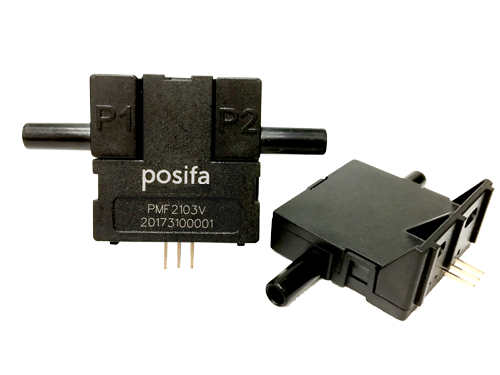
PMF2000 Series
General Purpose. Compact form factor. Measure flow rates under 10 SLM. Analog voltage or digital I2C outputs. Learn more...